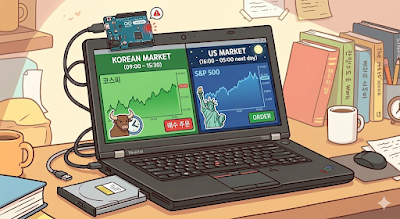
Many investors have been caught off guard by the sharp rally in the Korean stock market between 2025 and 2026.
For those who entered Inverse ETFs anticipating an overheated market, this has been a brutal period—to put it mildly. As of early May 2026, this upward trend is still going strong.
For the past four years,
I have actively traded Inverse ETFs using “Brawler” and “Trend Following” strategies.
After hundreds of backtests and real-world trades, I’d like to share my notes on why even day trading Inverse ETFs is so incredibly difficult.
1. Inverse ETFs are structurally against a growing market
It’s hard to deny that the economy and the stock market tend to go up over the long term.
Major indices we trade (like the S&P 500, NASDAQ 100, and KOSPI 200) have historically shown a consistent upward trend.
Because of this, Inverse ETFs are built to have a negative expected value; the longer you hold them, the higher the chance of losing money.
2. The index’s “automatic rebalancing logic”
Indices regularly remove underperforming stocks and add high-growth, blue-chip stocks.
It is a structure where a basket of “winners” is constantly being upgraded.
Betting against this structure puts an inverse trader at a natural disadvantage from the start.
3. The traps of Short strategies in real-world trading
Even though I used a tight Day Trading strategy—hardly ever holding positions overnight—I faced many painful challenges:
- Low Win Rate and Asymmetric Risk-Reward: Even when I used the same logic as my long strategies, my win rate dropped significantly. Big wins were rare, while big losses happened more often.
- Frequent Head Fakes: There were far more “fake-outs,” where the market looked like it was falling only to bounce back sharply. This is especially true in markets with a strong “Buy the Dip” culture.
- The Trap of Over-fitting: When you fine-tune your settings to make your backtest look profitable, you often end up with a strategy that only works on past data.
4. The gap between Backtesting and Reality
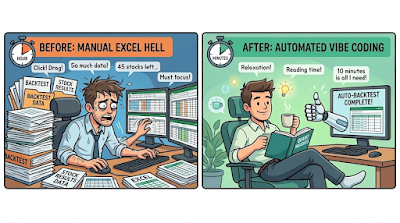
Strategies that looked perfect on paper often collapsed in real life.
This happened due to a mix of factors, such as a lack of data samples, liquidity issues, and sudden rebounds caused by Short Squeezes.
This was particularly prominent during the extreme volatility in the Korean market starting in late 2025.
Conclusion: Mental peace is a vital asset
In my current Alpha Trading System, I have scaled back my inverse strategy to a highly conservative level—executing it perhaps only once or twice a year. Effectively, I barely trade it at all.
Of course, there are many system traders who successfully generate stable profits using inverse products.
This post is simply a record of my personal experiences and failures, not a claim that everyone will fail.
From my strategic perspective, I have decided that it is more efficient to look for “alpha” in other areas rather than spending time on inverse products.
In system trading, it is often better not to put all your energy into fighting against the market structure.
Instead, look for areas that match your style and have a positive expected value.
This approach can lead to much better long-term results.